Hiring an Apprentice? Why Air Con businesses Should Start Before 1 January 2027
You've probably thought about it during the last heatwave: three jobs booked for the same afternoon, a ute full of gear, and only one of you. An apprentice would help. But between the wages, the paperwork and the time it takes to train someone, it's easy to put it off until "after summer".
This year, waiting has a price tag.
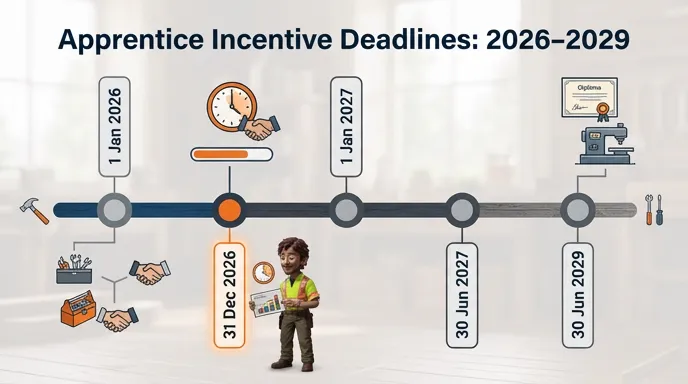
The short answer: if you run an air conditioning business and you've been thinking about an apprentice, sign them up before 1 January 2027. Start before then and you lock in an employer incentive of up to $5,000. Start on or after that date and the same incentive drops to up to $4,000 — and only businesses with fewer than 200 staff can claim it (DEWR). Your apprentice can also receive up to $10,000 in their own payments, and in NSW their TAFE training is currently fee-free.
Below is everything you need: the money, the dates, the real costs, the licensing rules, and a step-by-step checklist to get it done before the Christmas shutdown.
In practice, the real deadline is earlier than 31 December. Signing a training contract takes paperwork through an Apprentice Connect Australia Provider, and most offices slow down over Christmas. Aim to have everything signed by mid-December.

What money is available right now
Air conditioning and refrigeration is on the federal government's Australian Apprenticeships Priority List, and it's eligible under both "streams" of the Key Apprenticeship Program: New Energy (clean energy) and Housing Construction (DEWR Priority List). Both the main qualifications count: the UEE32225 Certificate III in Air Conditioning and Refrigeration, and the MEM31322 Certificate III in Refrigeration and Air Conditioning.
For you, the employer
For your apprentice
What changes on 1 January 2027
The changes were announced in the May 2026 federal budget (DEWR):
The employer incentive drops from up to $5,000 to up to $4,000, still paid in two instalments in the first year.
Big employers are excluded. Businesses with 200 or more staff can no longer claim (Group Training Organisations are the exception). This won't affect most air con businesses, but it does mean the big players lose a hiring advantage — good news for small operators competing for the same apprentices.
The Priority List is being reworked to reflect national and regional skills shortages over two years. Air conditioning is in a long-running national shortage, so it's likely to stay, but the 2027 list hasn't been published yet.
The program is extended to 30 June 2029 instead of ending on 31 December 2026.
What stays the same: the apprentice's own $10,000, the support loan, and the living-away-from-home allowance.
The grandfathering rule is the key point. Any employer who starts or restarts an apprenticeship before 1 January 2027 keeps the current rates for that apprentice. The date that counts is when the apprenticeship officially commences, not when you advertise or interview.
NSW extras: fee-free training
In NSW, apprenticeship training funded under the state's Smart and Skilled program is fee-free until 30 June 2027 — no upfront training costs for the apprentice or the employer (NSW Department of Education). That covers the TAFE NSW Certificate III in Air Conditioning and Refrigeration.
To be eligible, the apprentice must be an Australian citizen, permanent resident, humanitarian visa holder or New Zealand citizen living or working in NSW, and be enrolled in a Smart and Skilled-funded course.
Past extensions of this scheme have let apprentices who started before the cut-off keep fee-free training for the rest of their course. Confirm the current rule with your training provider when you enrol, but it's another reason not to leave it late.
If you're outside NSW, most states have their own training subsidies; your Apprentice Connect Australia Provider can tell you what applies.
The real cost of an apprentice
Incentives help, but they don't cover the full cost. Go in with your eyes open.
The payoff. By the second year, a good apprentice can mark out, core-drill, mount brackets, run pipe and clean up, while you do the work only a licensed tech can. In a trade where the average job brings in about $3,000 in revenue (HVAC&R News), finishing one extra install a week makes a real difference — and in four years you have a qualified tech who already knows how you work.
Licensing: what an air con apprentice can and can't do
Anyone who handles refrigerant needs a licence from the Australian Refrigeration Council (ARC) — apprentices included. They need a trainee licence (ARC).
Two types: a trainee licence (classroom and workplace) and a trainee classroom licence (TAFE only). Your apprentice needs the full trainee licence to work on site with you.
What they need to apply: proof of enrolment in their course, your refrigerant handling licence number, a signed supervisor declaration, and a photo.
It lasts up to 12 months and is renewed as training continues, then upgraded to a full licence once they qualify.
You are responsible. As supervisor, you declare that their refrigerant work meets the required standards. The supervisor must hold a licence covering the same work the apprentice is training for (ARC supervisor declaration).
Supervision is your call. The ARC says the level of supervision should match the work and the apprentice's progress — close at first, more independent later.
If they change supervisor, they must notify the ARC.
Electrical work is separate. Apprentices can't do electrical work without the right qualification and licence. In NSW, disconnect-and-reconnect work needs a licence that's usually gained near the end of the Certificate III. Until then, the licensed person does the electrical side.
Ways to take one on
A note on Group Training: a federal pilot that reimbursed small businesses for GTO placements closed to new applicants on 30 April 2026 (Plumbing Connection). GTOs still operate; there's just no extra reimbursement now. Note that with a GTO, the GTO is the employer, so it — not you — claims the employer incentive.
Where to find candidates: local high schools (ask about school-based apprenticeships and work experience), TAFE pre-apprenticeship courses, your wholesaler's trade counter noticeboard, and local Facebook community groups. Mention the apprentice's $10,000 in the ad.
Keeping them to the finish line
Roughly one in two apprentices across HVAC&R never finish their training (HVAC&R News). Losing one in year two means you've paid for the slow part and missed the good part. What helps:
Set expectations on day one. Explain what year one looks like: lots of carrying, cleaning, core holes and roof spaces. Surprises cause dropouts more than hard work does.
Give them real work early. Let them do a whole bracket mount or pipe run under supervision, not just fetch gear.
Watch the money milestones. Their $2,000 payments land at 6, 12, 24 and 36 months — remind them, and check in around those times. Money stress is a common reason apprentices quit.
Protect TAFE time. Don't pull them off block release for a busy week. Falling behind at TAFE is a fast track to quitting.
Plan for summer. Heatwave season in a 45° roof space is brutal for a first-year. Start mornings early, rotate roof work, and keep water in the ute.
Use a mentor. If you're always flat out, ask your Apprentice Connect Australia Provider about free mentoring support for apprentices.
Say when they've done well. Small thing, big difference.
Your checklist: start before 31 December
Work back from mid-December. Most of this can be done in a few weeks if you start now.
This week: decide whether you'll hire directly or through a Group Training Organisation.
This week: call an Apprentice Connect Australia Provider (find one here). They're free, handle the training contract, and confirm which incentives you're eligible for.
Late October: advertise. Mention the apprentice's $10,000 in incentive payments and fee-free TAFE (NSW).
November: interview, and do a trial day or two on real jobs.
November: check the award and pay rate with the Fair Work Pay Calculator.
By early December: choose a training provider (e.g. TAFE NSW) and enrol them in the Certificate III in Air Conditioning and Refrigeration.
By mid-December: sign the training contract through your Apprentice Connect Australia Provider. This sets the official start date.
As soon as they're enrolled: apply for their ARC trainee licence, with your supervisor declaration.
After they start: keep records so you can claim both employer incentive instalments in their first year.
The bottom line
If an apprentice is in your plans for the next year, starting before 1 January 2027 is worth up to $1,000 more to your business, puts up to $10,000 in your apprentice's pocket, and (in NSW) gets their training free. The paperwork is mostly handled by your Apprentice Connect Australia Provider, so the hardest part is simply starting.
One last thing. Training an apprentice takes attention, and that's hard to give when your phone rings every ten minutes. Every call you take mid-job is a lesson interrupted. That's the problem we built Nexus to solve: an AI receptionist that answers your calls, books jobs into your diary and follows up quotes, so you can focus on the job and the person you're training. Hear Nexus answer a real customer call.
This article is general information, not financial or legal advice. Incentive rules change; confirm your eligibility with an Apprentice Connect Australia Provider before you hire.

Sources