
Card surcharges are gone — but have you checked what you're paying instead?
If you've been adding 1.5% to card payments for years, there's an important change you need to know about.
Since 1 October 2026, businesses can no longer add a surcharge when a customer pays with Visa, Mastercard, eftpos or American Express.
But that's only half the story.
The Reserve Bank of Australia has also changed the way card payments work behind the scenes — including reducing some interchange fee caps and introducing greater transparency around payment costs.
So yes, you need to switch off your surcharge. But you should also be checking what you're paying your payment provider.
Why has this changed?
The RBA found that the way card payments were priced had become a complicated business.
The fees involved at different points in the payment process, businesses paid to accept cards, and many passed those costs on to customers through a surcharge. The reforms are intended to simplify the system, reduce some of those costs and make it easier for businesses to understand what they're actually paying.
So the RBA introduced a package of changes designed to make card payments simpler, more transparent and more competitive.
That package includes:
No more card surcharges for Visa, Mastercard and eftpos from 1 October 2026.
Lower interchange fee caps — interchange fees are one of the behind-the-scenes costs of accepting a card payment. The RBA has reduced the maximum amount that can be charged for these fees.
Greater transparency around payment fees, making it easier for businesses to compare what they're paying.
More information for businesses so they can shop around for a better deal.
The RBA says the changes are intended to help lower the total cost of payments and increase competition between payment providers.
American Express has also removed surcharging, although it isn't regulated by the RBA in the same way as Visa, Mastercard and eftpos.
What does that mean for a tradie?
There are really two jobs to do.
1. Stop charging the customer
You can no longer add a card surcharge to a customer's invoice simply because they paid by card.
You can't get around this by calling it a "payment processing fee" or adding a separate 1.5% line just for customers who pay by card.
The ACCC says businesses shouldn't try to avoid the no-surcharge rules by describing a card surcharge as another type of fee.
2. Check what you're paying
This is the bit that's easy to miss.
You still pay to accept card payments.
The surcharge disappearing doesn't make your payment processing free.
The difference is that you now need to treat that cost as part of running your business — just like fuel, insurance, software, wages and other overheads.
But that doesn't mean you should accept simply accept whatever your payment provider charges you. The RBA has reduced some of the underlying costs of card payments and is making fees more transparent, giving businesses a better opportunity to compare providers and find a better deal.
So don't just absorb the cost and forget about it. Check your rates.
Your payment provider may not be your best deal
When was the last time you actually looked at your merchant fees? If you've been with the same bank, payment provider or software platform for years, you may simply be paying whatever rate you were originally given.
For a tradie business, even a small difference can add up.
Say you process $200,000 a year through cards. A 1.5% processing cost is $3,000. At 1.0%, it's $2,000. That's a $1,000 difference without finding another customer or doing another job.
And if you're processing substantially more than that, the difference gets bigger.
Don't assume your rate will automatically fall
This is important. The RBA has reduced some of the costs involved in processing card payments. But that doesn't mean your payment provider will automatically reduce the fee you pay. Your provider still sets the price you pay for processing your card transactions.
So don't assume your costs have gone down just because the rules have changed. Check what you're actually paying and see whether you can get a better deal elsewhere.
In other words: Switch off the surcharge - then check what you're paying for card payments.
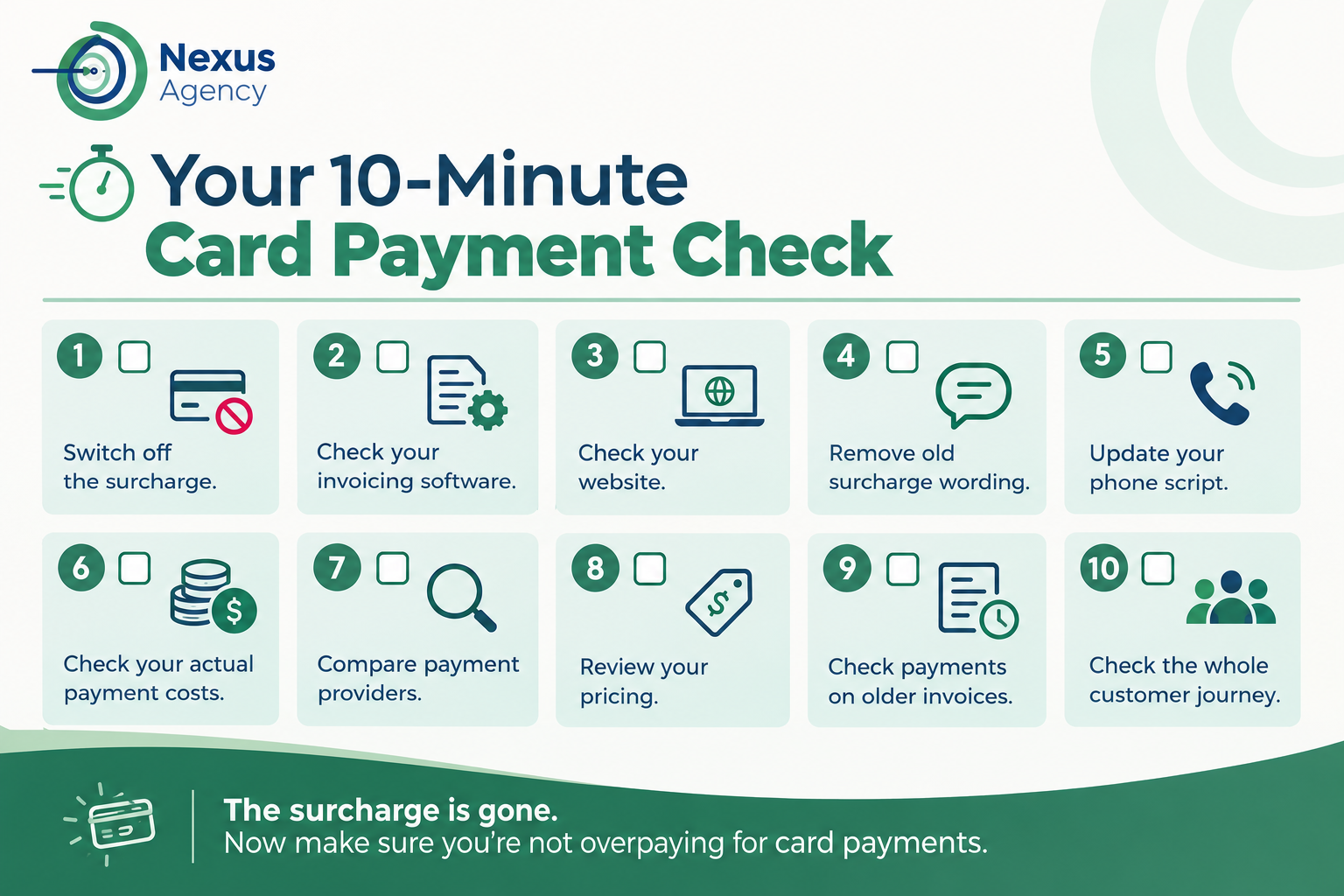
The 10-minute card payment check
A few things worth checking.
1. Turn off your surcharge
Check your EFTPOS terminal and payment settings.
If you're not sure whether it's been disabled, call your payment provider.
2. Check your invoicing software
Look for automatic surcharge settings or payment fees in your accounting and job management software such as Xero, MYOB, ServiceM8, Tradify or SimPRO.
Make sure an old setting isn't quietly adding a fee.
3. Check your website
Search for:
"surcharge"
Also check:
payment pages
booking forms
FAQs
terms and conditions
pricing pages
downloadable quote templates
4. Check your quote and invoice templates
Remove wording such as:
"A 1.5% surcharge applies to credit card payments."
5. Check your phone script
If someone calls asking:
"How much will it cost to pay by card?"
the answer shouldn't be:
"There's a 1.5% surcharge."
Make sure whoever answers the phone knows your new payment terms — including your AI receptionist.
6. Look at your actual payment costs
Pull out your latest merchant statement.
Find out:
What percentage are you paying?
Are there fixed transaction fees?
Are there monthly fees?
Are there terminal fees?
Are there other payment-platform fees?
Are different card types costing you different amounts?
What does your payment provider actually call each fee?
Don't just look at the headline rate.
Work out what you're actually paying per $1,000 of card transactions.
7. Compare your rate
Now get a couple of quotes from competing payment providers.
Give them your actual transaction volumes and ask for the effective cost, not just the advertised rate.
You're looking for the answer to:
"What will it actually cost me to process $10,000 / $50,000 / $200,000 of card payments?"
8. Check your pricing
If you've historically relied on a surcharge to recover card costs, you now need to decide how you're going to absorb that cost.
You can incorporate your payment costs into your overall pricing.
For example, if a $1,000 job used to have a 1.5% card surcharge, you may decide that the cost of accepting payments is simply part of your overall pricing now.
The important thing is that your advertised price and the final price you charge the customer are clear and accurate.
9. Don't forget old invoices
If a customer pays an old invoice today, you can't add a card surcharge just because the original invoice was created before 1 October.
The rules apply to the payment being made now.
10. Check everything your customer sees
Your website, quotes, invoices, booking system, phone scripts and payment terminal should all tell the same story.
No surprise card fee at the end.
What about other fees?
The new rules don't mean you can't charge any other fees.
Genuine fees for things such as booking, delivery or other services can still exist, provided they aren't simply a card surcharge disguised under another name.
The important question is: Is the customer paying this fee because of something you're providing — or simply because they chose to pay by card?
So what's the real takeaway?
The obvious change is:
You can't charge your customer a card surcharge anymore.
But the bigger change for small businesses is this:
You now need to treat payment processing as a business cost — and make sure you're not paying more than you need to.
The RBA has reduced some underlying card costs and is making payment fees more transparent precisely so businesses can compare providers and shop around.
So don't just switch off that 1.5%. Spend another ten minutes finding out what you're paying instead. A payment provider you've been with for years might not be the best deal anymore.
And $10 here, $20 there might not sound like much. But across hundreds of jobs a year, small percentages become real money.
One last thing
There is one other lesson in all of this:
Customers expect businesses to have the right information at their fingertips.
Payment terms are just one example. Customers also want quick answers about pricing, availability, bookings, services and what happens next.
If you're out on a job, driving between jobs or already talking to another customer, being able to answer those questions doesn't have to mean stopping what you're doing. That's where an AI receptionist can help. It can handle common questions and provide consistent, up-to-date information while you get on with the work.
For a busy trade business, that's one less thing completing for your attention. That's what Nexus Agency does for Central Coast tradies. Book a demo.